Tarama Village
Fumie Hamakawa
Te-ORI Kobo HAMAKAWA
Grow, spin, and weave Gunbou
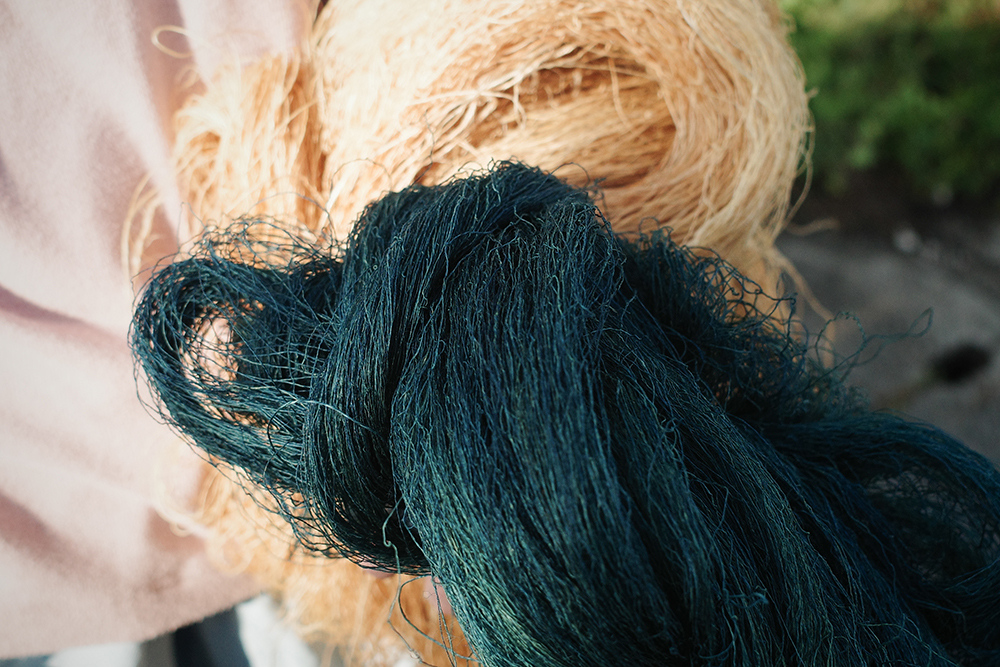
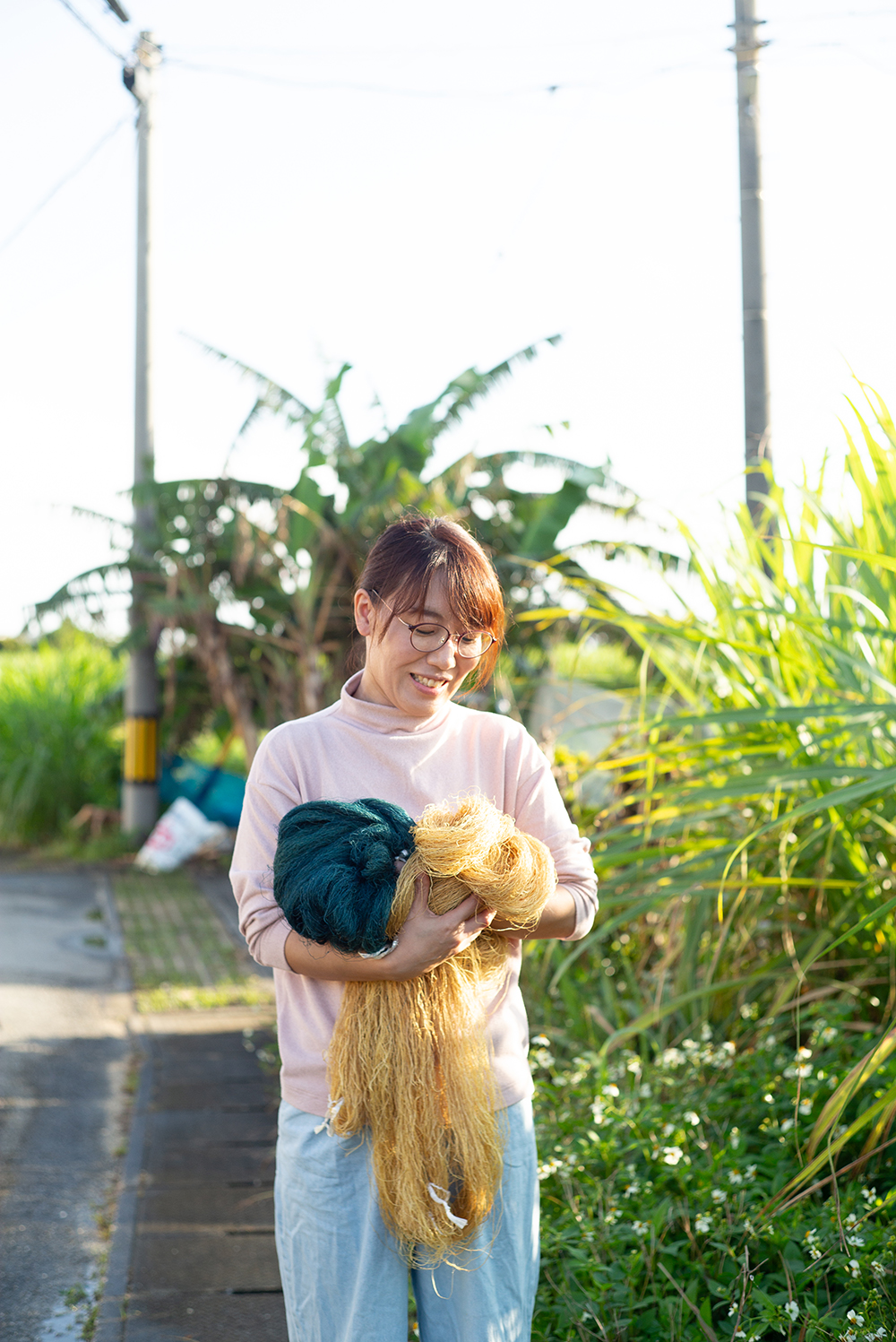
“These threads are handspun with Choma (ramie) and dyed with Fukugi (common garcinia),” said Fumie Hamakawa as she handed me a thick bundle of gentle yellow threads. When I held it in my arms, it was soft and light, and its airy and cool texture was comfortable.
A unique characteristic of Tarama Gunbou is the use of Choma thread –or Karamushi– for the warp and Basho thread for the weft. Basho thread is the material used for Basho-fu (Basho cloth), a well-known handicraft from the main island of Okinawa. The process of making Tarama Gunbou starts by cultivating the raw material from the plant, obtaining the fibers, making the threads, dyeing, and finally weaving. Among the plant fabrics produced through such an extraordinary process, Hamakawa explains, Tarama Gunbou is “a fabric that uses the best parts of each fiber,”.
In fact, it was not so long ago that Tarama Gunbou was born. Several decades ago, the late Hide Irisuji –a textile artist from Tarama Village– devised it in hopes that it would become a specialty of Tarama. At that time, she was the only weaver of the cloth.
It was more than 20 years ago when a Tokyo-born Hamakawa first encountered this textile. She was learning Yaeyama Joufu on Ishigaki Island after graduating from an art college.
“One day, my teacher said he was going to Tarama, so I went with him and found out his purpose was to visit Hide Irisuji. For some reason, that scene has remained in my memory for a long time.”
As her time learning on Ishigaki Island was coming to an end, she was pondering what to do next, and she recalled her time at Irisuji’s house. Hamakawa thought that Irisuji, being elderly, could use some help. She also hoped to learn how to spin threads, something she could not learn in Ishigaki. On a hunch, she visited Irisuji, only to be welcomed more warmly than she expected. From then on, Hamakawa spent her days with Irisuji until the elder stopped weaving.
“The world of traditional craft is tough. Even if you want to learn from a master, you are often turned down, and there are many masters who have a high threshold. But Ms. Irisuji accepted me wholeheartedly and treated me like her family. It is thanks to Tarama and her that I am here today.”
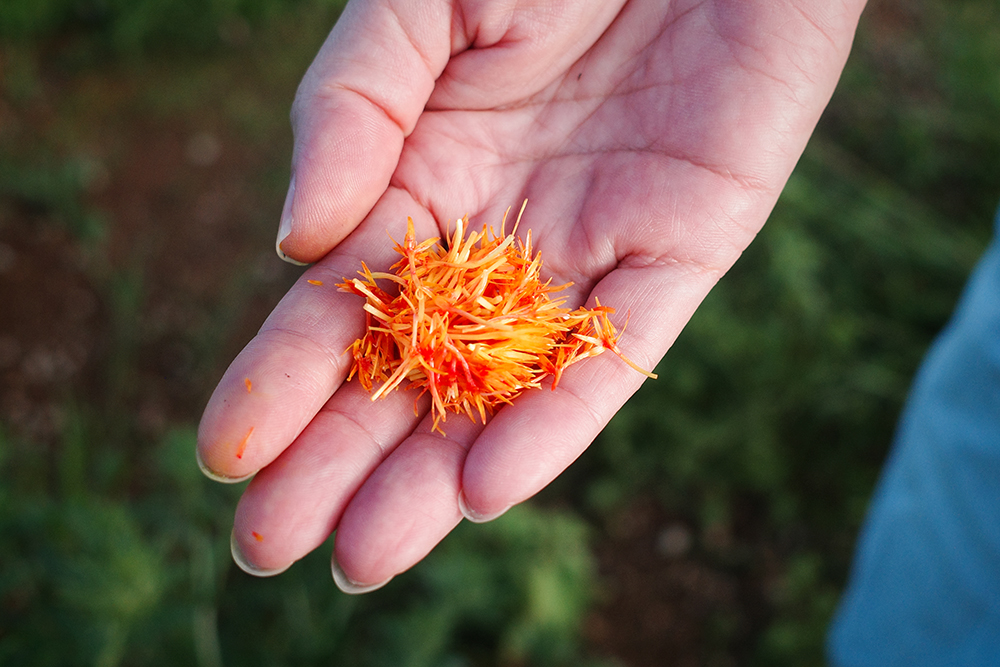
Irisuji handed down all of her skills before her passing in 2021 at the age of 96. Hamakawa is now the sole weaver of Tarama Gunbou. Hamakawa continues to produce works and belongs to the “Miyako Bunmi (Choma Spinning) Preservation Society” based on the main island of Miyako. While deepening her studies with her friends, she also holds hands-on workshops to pass on her skills to local children. She is also eager to develop special products utilizing Choma threads and the dye of the village flower Taramabana (safflower).
Of the many processes involved in Tarama Gunbou, the most difficult one for Hamakawa is making the threads. And the one she enjoys the most is the Bubiki, which is to extract the fiber from the plant. “I'm clumsy, so I've made all kinds of mistakes,” she laughed, then added, “But maybe being clumsy and slow makes me want to work harder to be able to acquire the skill.”
“I feel that Choma thread and Tarama Gunbou are one of the few ‘genuine’ products left in a world where genuine things have become a rarity. Therefore, I would like to keep going, working slowly and carefully, no matter how many times I make mistakes.”
Interviewed in April, 2025
Writer : Mikiko Tamaki / Photographer : Hiroyuki Tamura