Hayakawa TownKazuyuki Tsuji
Mayor (1980-2024)
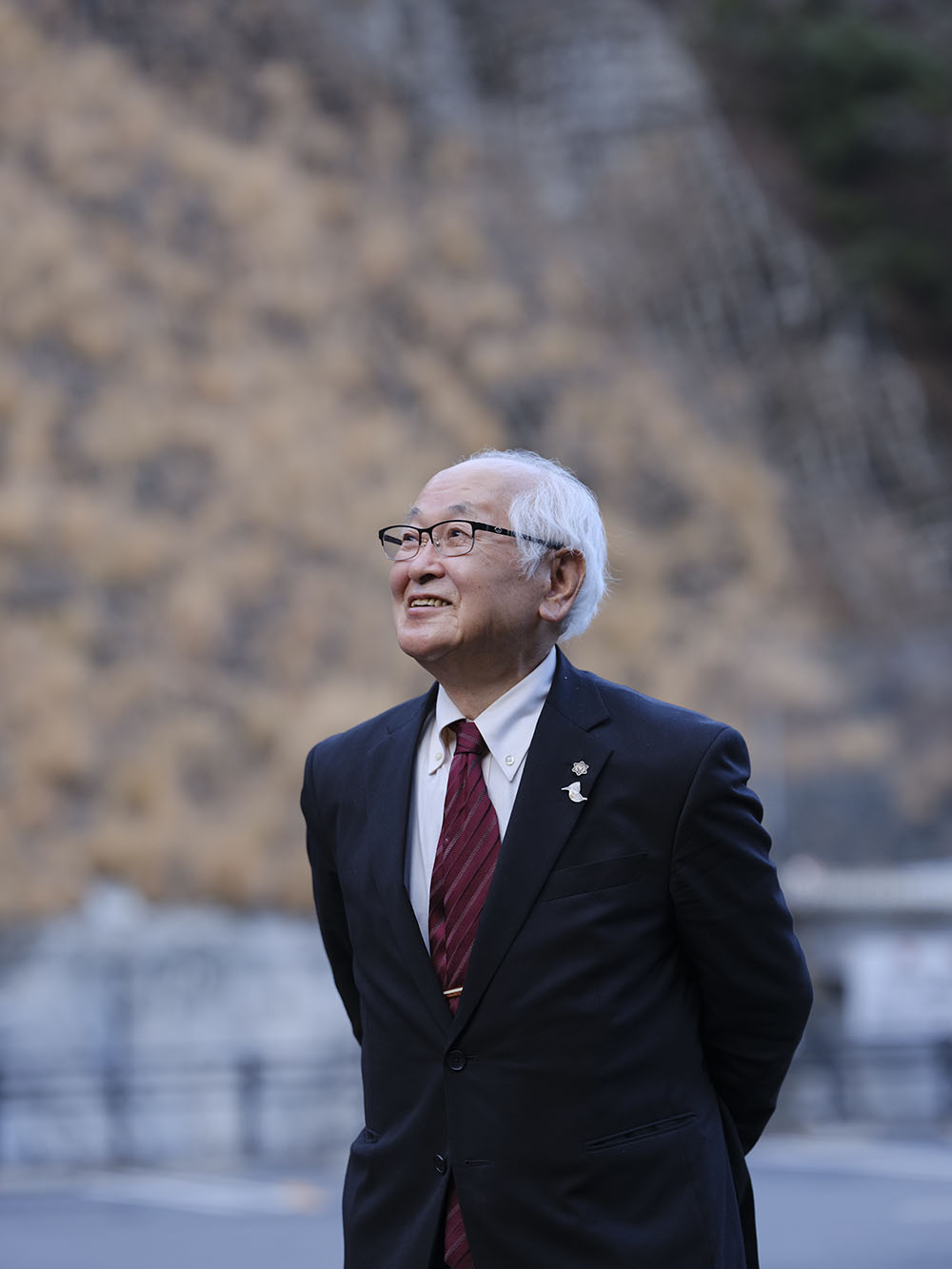
“The richness of municipalities is in the happiness levels of each individual.” The 81-year-old “Mayor” continues to demonstrate the world the significance of protecting the water source = the town in the upper reaches.
A beautiful town is in a spiritually rich life and daily happiness.
It was in 1980 that I was appointed Mayor. The population of 8,000 at the time of the merger in 1956, had already dropped to around 3,000. After assuming the office, against the current of the times, I promoted “town development to discover resources existing near each of the old villages (6 villages) and create a vibrant place”. The overconcentration is seemingly efficient, but the outflow of residents occurs from the area that has become a “remote region”, and the disappearance of villages will accelerate in the current population size of the town. Hayakawacho is an aggregation of each region taking pride in the place where they live. To show that, we have explored the characteristics of each of the six villages, such as “Unexplored place Naradano-sato,” “Southern Alps Wild Bird Park and Healthy Misato,” and “Amehata Suzurinosato Development,” and set a relaxing place where the townspeople gather. There are many elementary schools in terms of population size, but we have no intention of reducing the number to less than two because of the thought that people gather where there is education.
Eventually, the great merger of municipalities in the Heisei period came. In the time that 1,353 municipalities merged in the three years from 2004 to 2007, I first picked a route of “hearing to each of the townspeople.” As a result of arranging an opportunity for the townspeople to think and discuss together, and finally conducting a questionnaire, 60% of the responses were “deferment of the merger”. Regarding the rest of the opinions, 30% were that “merger is unavoidable” and 10% were “That's the tendency nationwide.” In other words, most of the townspeople thought, “I don't want to merge if possible.”
Consequently, Hayakawa-cho decided to “deferment of the merger” and came to move forward as “the smallest town in Japan”.
In the first place, if the affluent daily lives of people living in the water source in the upper reaches like us are protected, I wonder if people living in the lower reaches might also enjoy the irreplaceable value such as delicious water and fresh air.
Interviewed in January, 2021
Writer : Mikiko Tamaki / Photographer : Kenta Sasaki