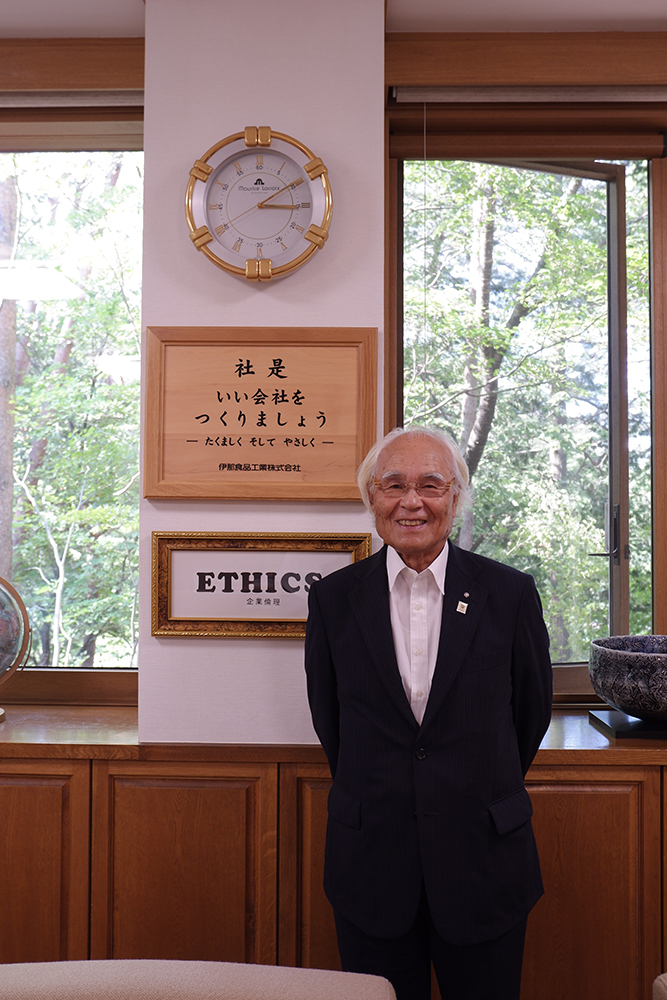
Hiroshi Tsukakoshi
Senior Advisor, Ina Food Industry Co., Ltd.
Hiroshi Tsukakoshi has been involved in the management of The Most Beautiful Villages in Japan Association since its establishment. After serving for many years as Vice Chair, he continues to play a leading role in advancing sustainable community development as a member of the Board of Directors. Through Ina Food Industry, he has also undertaken practical initiatives to connect local communities to the future, including the business succession of a sake brewery in Nakagawa Village—a neighboring “beautiful village” that had been facing the risk of closure.
Fostering the strength of beautiful villages through a shared commitment to pride and steady, incremental improvement.
Located in the western part of Ina City, near the Tenryu River, is the headquarters of Ina Food Industry. The site, covering approximately 30,000 tsubo (about 100,000 square meters) and including the headquarters building, is known as Kantenpapa Garden. Within these grounds, food manufacturing facilities that can be viewed by visitors, along with a restaurant, an art museum, and other amenities, are scattered among a rich grove of Japanese red pine trees.
“Yesterday, this area was hit by heavy rain and strong winds due to a typhoon. Many leaves and branches fell,” Hiroshi Tsukakoshi explains. “But as you can see, everything was already cleaned up by the morning. Our employees voluntarily take the initiative to tidy the grounds, ensuring that the site is always maintained as a beautiful garden.”
Mr. Tsukagoshi’s involvement with The Most Beautiful Villages in Japan Association dates back to its founding. “Mr. Matsuo* approached me and asked if I would support the initiative. I assumed that meant not only offering ideas but also providing financial backing,” he recalls with a smile. “Nevertheless, I saw it as a meaningful effort aimed at regional self-reliance and the preservation of local culture, and decided to take part.”
* Masahiko Matsuo, founder of The Most Beautiful Villages in Japan Association (former President of Calbee, Inc.; deceased)
Since then, he has visited “beautiful villages” across Japan, including Biei Town, Akaigawa Village, and Tsurui Village in Hokkaido; Kamijima Town in Ehime Prefecture; Ama Town in Shimane Prefecture; and Ine Town in Kyoto Prefecture, among many others.
The Ina Valley in southern Nagano (Minami-Shinshu), where the company is based, has also become home to a notable concentration of such communities. Following Takato Town in Ina City, which was the first in the area to join as a regional member, a number of municipalities—including Nakagawa Village, Oshika Village, and Kiso Town—have joined the association. Over time, the region has come to be recognized as one of the country’s leading clusters of “beautiful villages.” Turning his gaze once again to the view outside the window, Tsukakoshi remarks, “The activities of the ‘Beautiful Villages’ movement are not unlike the making of this garden.”
“Why do our employees clean the grounds on their own initiative? It is because they take pride in this company. Pride draws out the potential of each individual and serves as the driving force behind voluntary action. In the same way, I believe that the ‘Beautiful Villages’ movement should exist as a reason for local residents to feel proud of the place where they live.” Ina Food Industry has long upheld a management philosophy known as nenrin keiei—“annual ring management”—which places the happiness of employees first and values steady, gradual growth over rapid expansion. Tsukakoshi emphasizes that what is essential to putting this philosophy into practice is precisely this sense of pride.
“Of course, for people to feel proud of their company, there must be a sense of satisfaction that includes working conditions and employee benefits. I myself have received a number of awards over the years, from both public and private sectors. I believe the greatest significance of those honors lies in the fact that our employees can see external recognition of the company’s management and feel pride in it.”
“Let us replace this with the idea of ‘Beautiful Villages’ and consider it as something that exists so that the people of towns and villages can take pride in living in their communities.”
Raising the visibility of the ‘Beautiful Villages’ designation itself is extremely important, and it is also essential that member communities are able to feel tangible economic benefits from their participation.” To enhance the value of membership in the Beautiful Villages network, Tsukakoshi suggests that “it may be important not to increase the number of member towns and villages indiscriminately.” He continues, “Another key issue is how far we can go in supporting economic self-reliance. For example, I hope we can engage in active discussion about matters such as receiving support from the national government. There is still much that this ‘Beautiful Villages’ movement can accomplish.”