NakanojoPreservation Group of Nedofumi Homeland
Preservation Group of Nedofumi Homeland
Nedofumi is a traditional craft in Kuni, which is a way to process sedge straws for Konkon-zori sandals. Handcrafted by local women, each set of the sandals has unique design.
Like wearing wild grass
Kuni is located 600 to 2300 meters above sea level. Surrounded by mountains, the ground is not level which makes Kuni an unsuitable place for paddy. Local people make use of sedge straw instead of rice straw to create various daily wares. The fiber of sedge is sturdy. So it is soaked in the hot spring of Shiriyaki Onsen, then trampled or beaten by wooden hammer to soften: this technique is called “nedofumi”. The term “nedo” is a derivative of a Japanese word meaning “a place to let rest” (rest the grass in hot spring). As a result of nedofumi the material made with sedge are tough and glossy and is used to make ropes and mattresses.
Konkon-zori sandals are made using the sedge material as a supporting rope. The shape of the sandal is like a slipper with domed instep. These are made in winter as one of the winter tasks in the snowy region by the mother of a household. The technique would be taught and handed over to daughters. One of the characteristics of the sandals is the colorful design made with cloths. They are sold at the stores in road stations and ryokans (Japanese style inn) as a souvenir product.
The Preservation Group of Nedofumi Homeland was established by local women of over 70 years old to hand over and preserve the technique of Nedofumi. They hold workshops of Konkon-zori sandal making in the atelier placed in Nedofumi Homeland, located in a corner of an old renovated house.
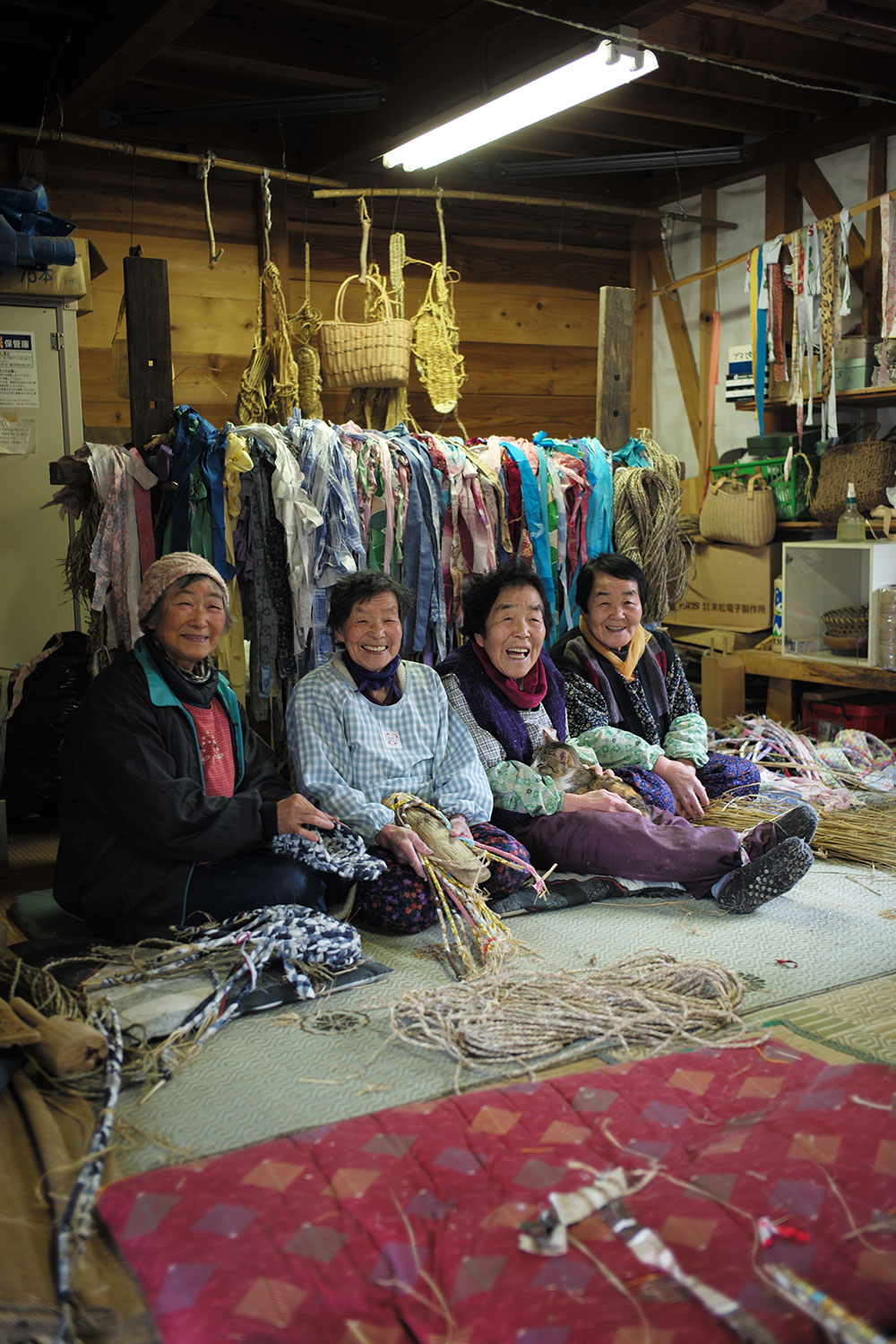
We visited their atelier to observe the process of Konkon-zori making to find four women being absorbed in the work respectively, siting on tatami-mat floor with their feet stretched out. They use their toes skillfully to secure a few strands of straw in between to wrap colorful cloths around. “The design of the sandals depends on the cloths we get each time and the shape depends on the person who makes it. There are people who are especially good with designing color layout,” says Tora Nakamura, a reliable leader type. Behind the ladies there are tons of colorful cloths hanging like sashes. Those cloths, both used and new, are laid in from futon shops. They then cut the cloths and wrap it around the straw to reinforce it. The cloths determine the overall impression of the design.
Konkon-zori are made by hand, braiding the cloth-wrapped rice straws around the sedge rope. The region is not suitable for growing rice so they get rice straws from other regions such as Sawatari. To use the straws for making sandals, they need to crop the straws by hand to make the length uniform. It is time-consuming just to get hold of the straws. “We ask our friends to lay in the straws each year. We don’t need more than we can make. We have enough for this year,” says Utako Yamaguchi. There are bunches of straws everywhere in the atelier, which will be beaten on a stone to soften. Straw keeps the feet warm and the cloths make the sandals soft and comfortable to wear. You hear practical conversation from time to time but mostly they are quiet and concentrate on their work at hand.
A cat named Hana is taking a nap on the lap of Chiyoko Nakamura, sister of Tora. “I’d make mistakes if I talk too much while working. Besides, I am hard of hearing so I can’t hear what my sister is saying. It is better we don’t chat,” laughs Chiyoko. A radio is their companion while working. “We take breaks at 10:00 am and 3:00 pm. We’re easy-going.” “We have less sandal makers now. Once they leave, it is hard to recall the process. We hope we can hand over the craft to younger generation but not many young people are willing to do it,” says Tora.
On a break time someone brews coffee with the hot water in the pot on the stove. Then they get back to work. The comfortable sound of a wooden hammer knocking the sandals for shaping echoes. The onomatopoeia of this sound in Japanese is “kon-kon,” thus Konkon-zori. There are things you cannot bring back once you’ve lost them. The technique to make Konkon-zori is certainly one of them.
Interviewed in January, 2020
Writer : Hideko Takahashi / Photographer : Hiroyuki Tamura