Manno Town
Yukio Takao,
Takashi Miyaji, and
Hidenobu Sano
Shimagamine Original
Landscape Preservation
Society
Higher than the peak of Tokyo Skytree, with temperatures fi ve degrees cooler than at the foot of the mountain.
This is “Shimagamine,” a sky-high land at an elevation of 900 meters. Located in Kagawa, also known as Udon Prefecture, it’s a buckwheat-growing area.
Driven by a desire to restore the original landscape of their childhood, a group of local volunteers came together and began reclaiming this abandoned land eight years ago.
What once seemed like an impossible challenge has now borne fruit, leaving visitors with something more than just a beautiful view—something that lingers in their hearts.
Landscapes that move the hearts of those who see them are created by the thoughts of the people.
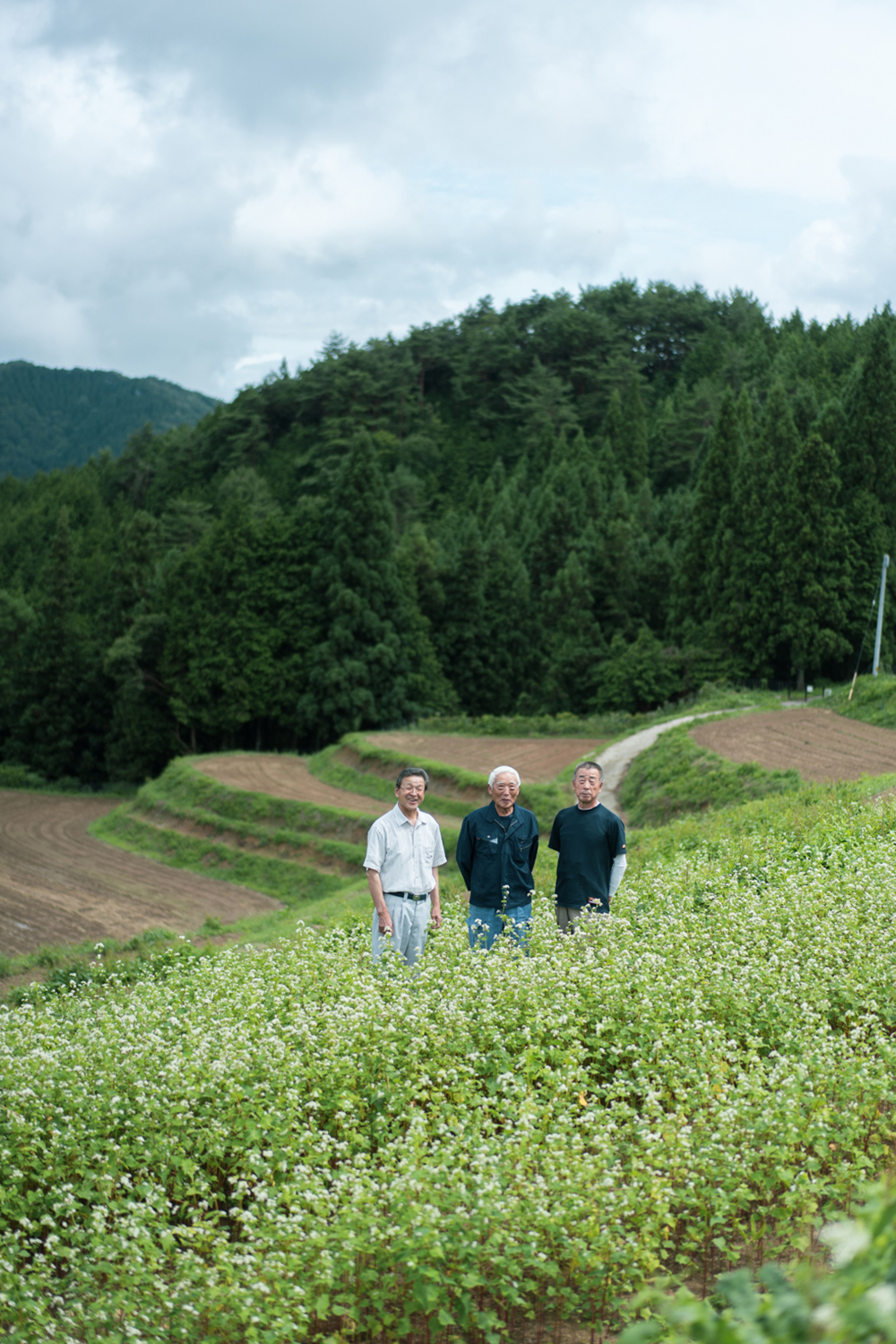
As you wind your way along the narrow, rugged forest road, the view suddenly opens up to reveal terraced fields of buckwheat with the Sanuki Mountains looming close. Every year in late September, many people from inside and outside the prefecture visit this famous spot to catch a glimpse of the white buckwheat flowers that spread all over the place. The contrast between the gently sloping terraces and the majestic mountain range creates a scene that feels like stepping into a fairy-tale world.
Taking advantage of the cool climate, Shimagamine was developed as a ranch around 1960, and later as a cabbage field. However, due to changing social conditions and an aging population, the area gradually declined, turning into overgrown, abandoned land. In 2016, efforts to restore the landscape of Shimagamine, where time seemed to have stood still, began. Mr.Miyaji and Mr.Sano, both locals who had retired and taken on roles as "Community Support Officers" to revitalize the area, rallied a group of twelve volunteers to form the “Shimagamine Original Landscape Preservation Society.” The region around Shimagamine has a tradition of buckwheat cultivation, benefiting from the significant temperature differences between day and night. With a desire to create a beautiful landscape by cultivating buckwheat that would bloom with delicate flowers and to pass this legacy on to the next generation, the group began by reclaiming the overgrown land.
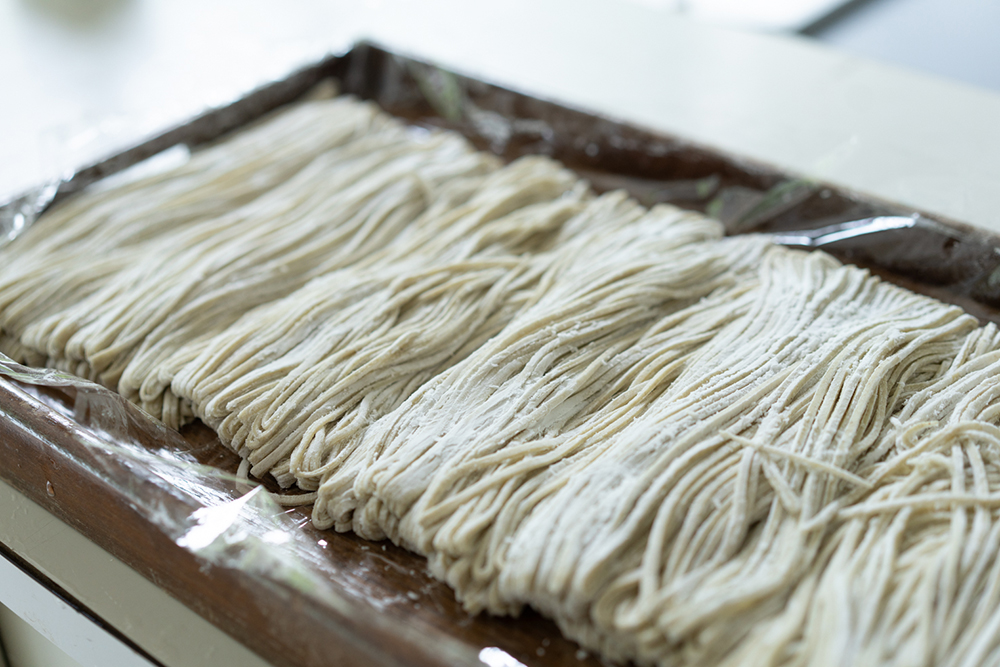
“This endeavor was only possible because of Mr. Takao and others, who have been running the ‘soba-making dojo’ at the local community center for over 20 years,” says Mr. Sano with deep appreciation. The soba-making dojo was started by Mr. Takao, a former councilor of the old Kotonami Town, as part of an initiative to promote urban-rural exchange and pass down the region’s food culture. To date, more than 3,000 people from within and outside the prefecture have participated, and the program has attracted many repeat visitors.
The land reclamation work, which they began through trial and error, was reportedly a series of hardships. Looking back, Mr. Miyaji refl ects, "I think I did pretty well, if I do say so myself." By continuing the enormous work steadily, the land was gradually restored to terraced fi elds. After their fi rst sowing of seeds, they held the inaugural
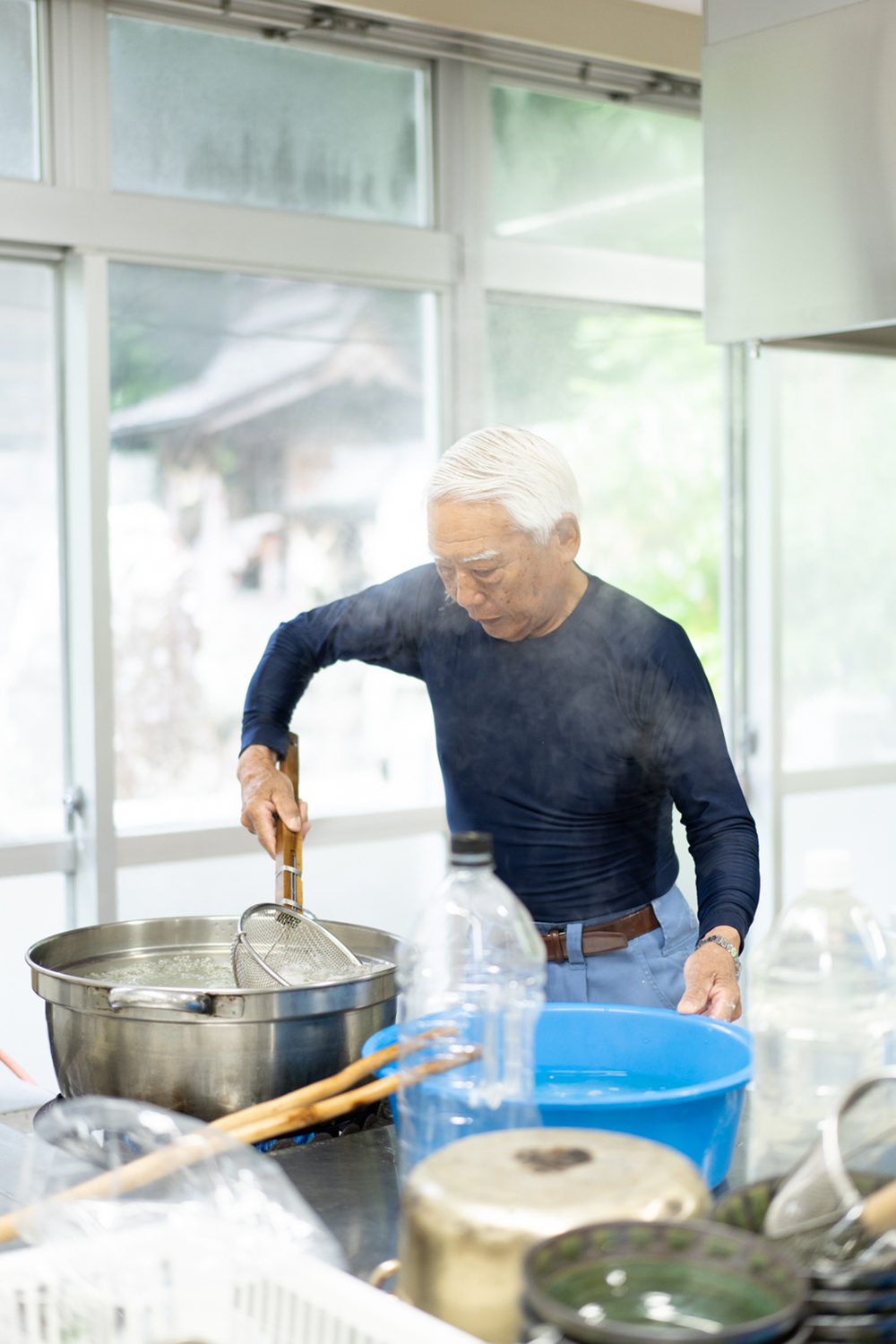
Soba Flower Viewing Event in late September 2017, when the fields were in full bloom with white flowers. “Unexpectedly, a lot of people came, and when I started talking to the visitors, they were delighted. That’s when it really became enjoyable for me,” Mr. Takao remembers. Since then, the flower viewing event has become an annual tradition, and on the opening day, they serve 350 complimentary bowls of soba. "The goal is simply to have as many people as possible come to Shimagamine. That's why it's a 'hospitality event,'" says Mr. Sano. From cultivation and harvesting to milling and cooking, they handle every step themselves, with the whole community pitching in to welcome visitors. “Seeing the joy on the faces of those who come here and watching this place come to life—that’s what makes us happiest,” the three of them agree.
One might expect that they plan to further expand their operations, but that isn’t their primary goal. “Increasing our yield is important, but what we’re really aiming for is to preserve the culture and landscape,” Mr.Sano explains. “We’re committed to growing soba the traditional way, just as it has been cultivated in this area for generations. That’s why we grow it organically, and we’re now working to increase our stock of heirloom seeds so that, going forward, we can focus solely on cultivating native varieties.”
Over the past decade, Shimagamine has undergone a remarkable transformation. "It's gone from a place where no one could even set foot to being this beautiful, and everyone is amazed," says Mr. Miyaji. Mr. Sano adds, "An elderly woman from this area came to see it and was delighted, saying, 'It feels like the old landscape is coming back.' We’re very grateful for that."
Most members of the Shimagamine Landscape Preservation Society are in their seventies. However, inspired by the passion of people like Mr. Takao, younger members in their twenties and forties have started joining, gradually bringing new energy to the group. Local residents have also voiced interest, with some saying, "I’d like to help out after I retire."
"In my grandfather’s, grandmother’s, father’s, and mother’s generations, people worked hard and supported each other in the community. We grew up watching that, so we want to do what we can and pass it on to the next generation," Mr. Sano shared earnestly.
In a beautiful landscape, you can sense the hearts of the people who created it. Mr. Takao’s words, "Even without bias, I think the scenery of Shimagamine is truly beautiful," resonated deeply with me.
Interviewed in October, 2024
Writer : Atsumi Nakazato / Photographer : Eri Tokura