Chizu Town
Yoshifumi Otsuka
Otsuka Forge
From kitchen knives to tools for farming, fishing, and mountain work, nokaji, or blacksmith, holds a vital role in crafting and repairing essential tools for everyday life.
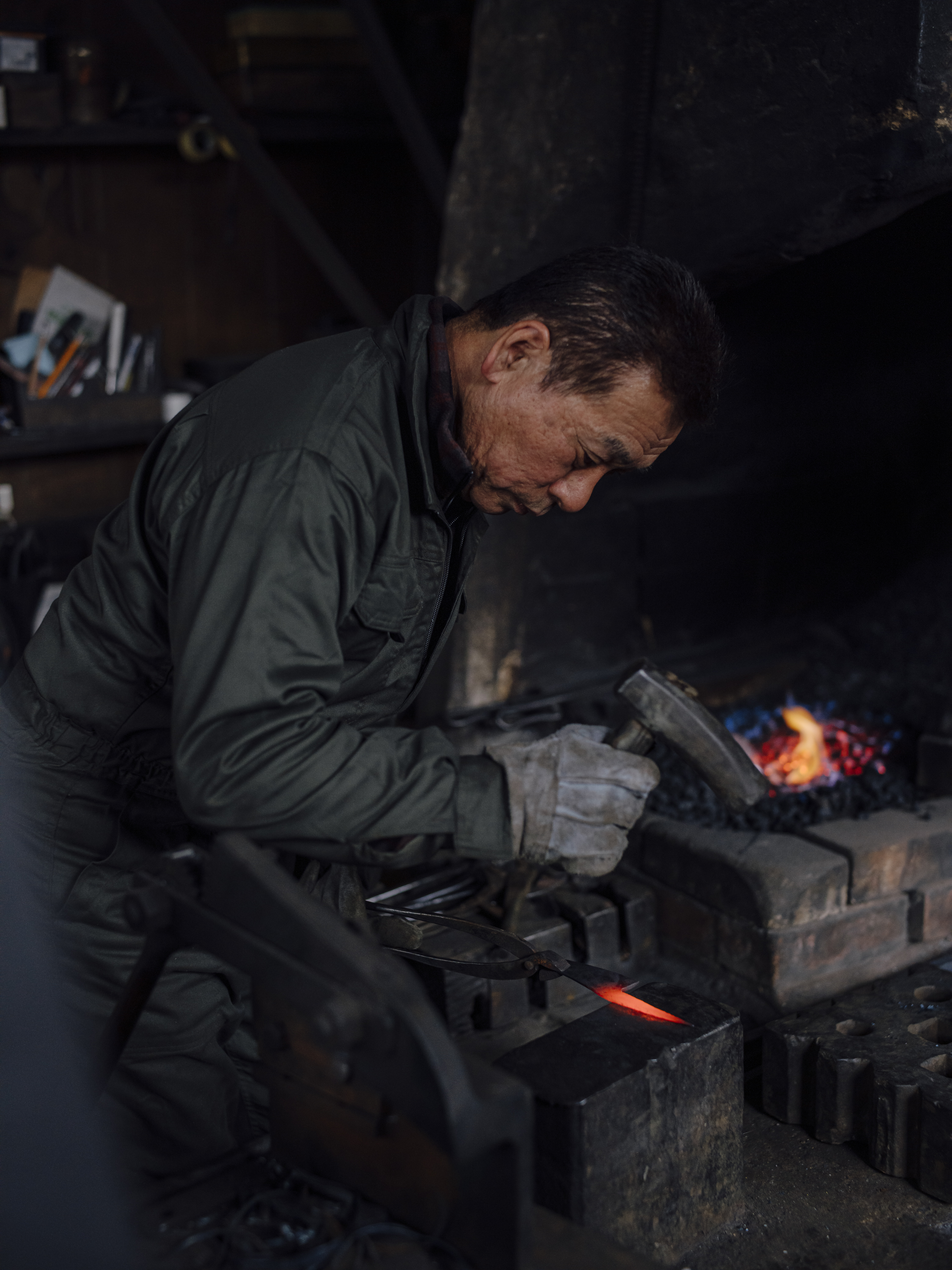
Yoshifumi Otsuka embarked on his career following his father’s path at the age of 33. Despite a minimum one-year wait for his custom-made knives,
they are revered by renowned chefs worldwide. These knives are crafted in a small house nestled in Chizu-cho.
“Chizu is where I belong, and because I have a place here, I can work.”
Nestled in a quiet corner in front of Haji Station on the Inbi Line, amidst a row of houses stands Otsuka’s home and workshop. It’s easy to overlook, but if you pay attention, you’ll sense the aura of craftsmanship emanating from this distinctive adobe. I peeked inside to find out that my hunch was correct, it was Otsuka’s workshop.
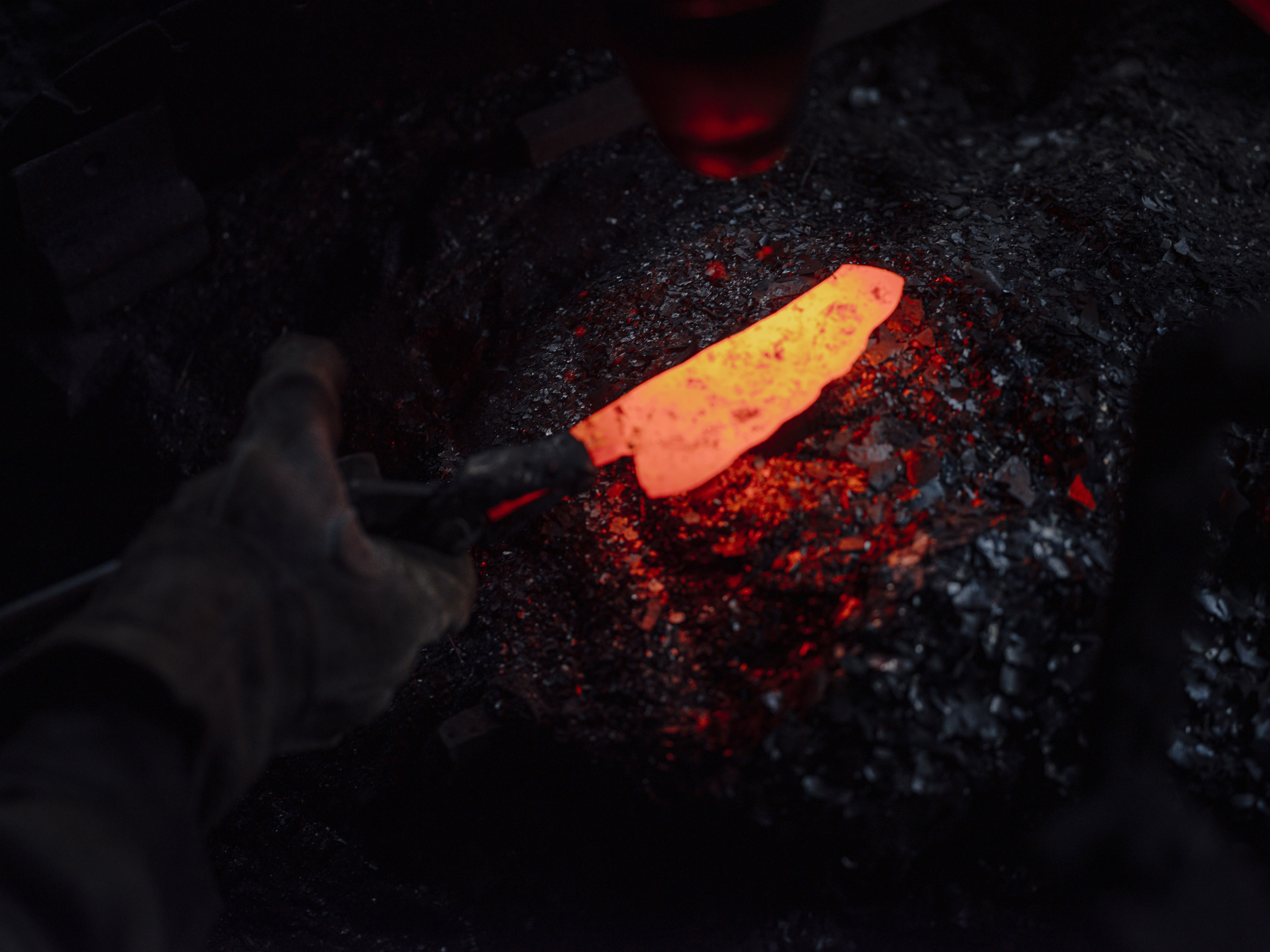
Otsuka’s knives are renowned globally, attracting orders from far and wide. I was told that Otsuka is so busy that he rarely accepts interviews, but when I visited him, he opened the sliding glass door and greeted me with a soft smile. “I never accept interviews except for the Most Beautiful Knives in the World,” he said jokingly. “I'll make one knife in front of you so use these,” said he, kindly handing a pair of earplugs for each of us.
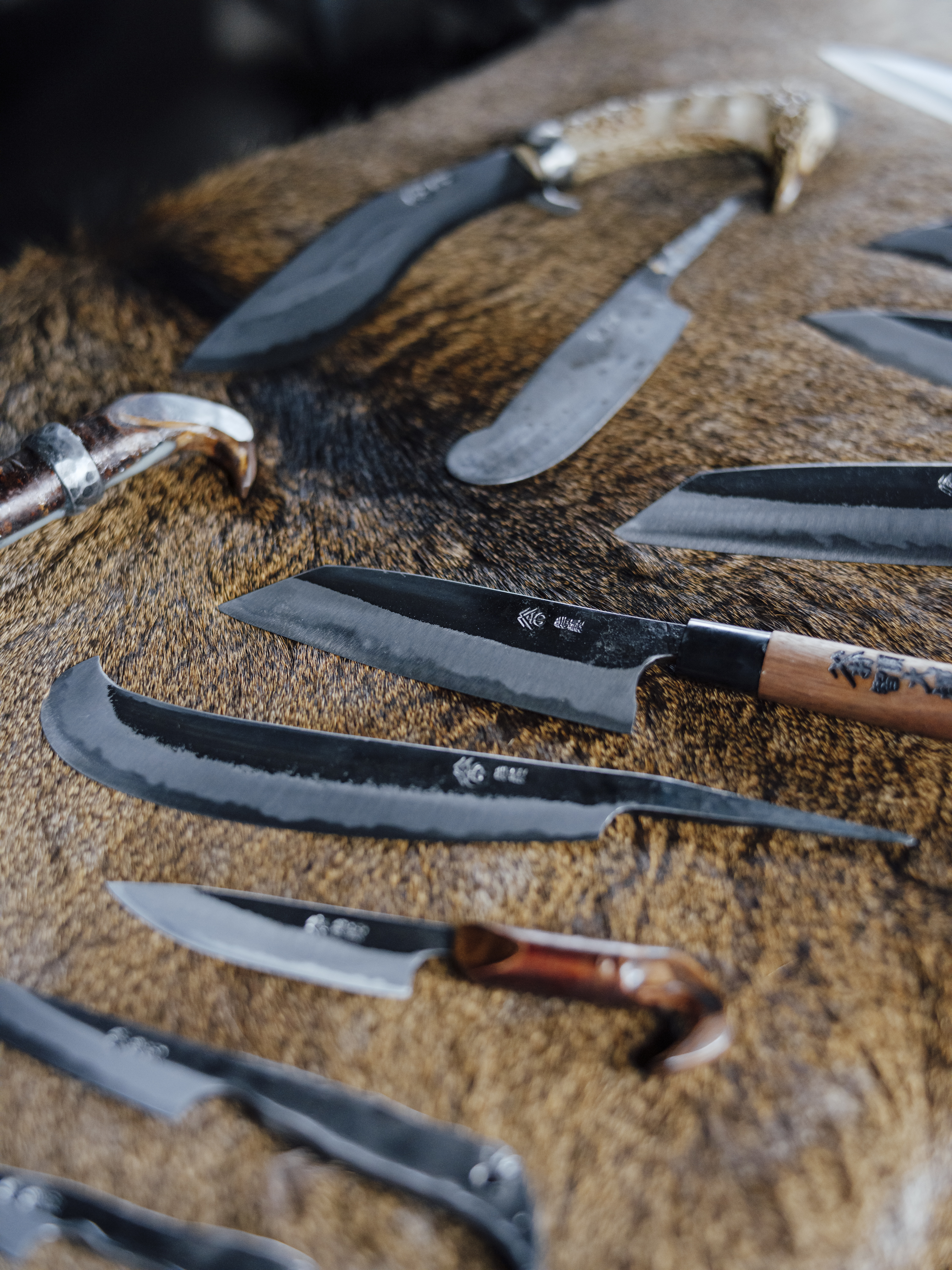
Yoshifumi Otsuka, a third-generation nokaji, continues his family business started by his grandfather. Displaying his creations, it’s evident that each knife if unique— varying in size, blade length and handle material and shape. And these are only a small part of his creations.
“Nokaji’s role in crafting knives is to tailor them to individual preferences,” he says, and in the course of responding to each individual request, he has come to produce more than 60 different types of knives, roughly classified.
Many of Otsuka’s creation are inspired by his close ties with the community in Chizu. For instance, he crafted knives with cherry branch handles upon request of Setsuko Teratani, the proprietress of Mitakien. “I made it when she approached me and said she wanted to sell my knives. She wanted to make knives for women in their 30s and 40s cutting bread and cakes around the table. She also wanted handles made of natural wood, which complements Mitakien’s ambience. That was the first time used cherry branches.” Additionally, antler handles, sourced from Chizu Deer’s, a local gibier processing facility. “I went to school with the guy who operates the business. The handle made with antler is easy to use on the boat to prepare fish because your hands don't slip.” Otsuka’s knives are often used overseas, but his daily connection with Chizu lives on in each of his knives.
Walking around the town, we find Otsuka’s knives playing an integral role in the local people’s daily tasks. At Minna no Shokudo, a restaurant run by a guesthouse in front of Chizu Station, Tanoshi, we found their chefs slicing prosciutto with Otsuka’s cherry-handle Yanagiba knife, a Japanese kitchen knife for sashimi. Similarly, Otsuka’s knives play an “indispensable role” at Talmary bakery. “The dough made with our homegrown natural yeast tends to be very soft and acidic. Nothing beats Mr. Otsuka’s sharp blade to score the dough. Razors are often used for scoring, but they tend to wear out quickly,” said the owner Watanabe.
Listening to each of these episodes, Otsuka’s face wrinkled with joy. “I’m glad I was born in Chizu. There are probably a lot more fun places out there, but this is where I belong. I can work because I have a place to belong. By the way, every year I make knives for the children who graduate from Morino no Youchien (Forest Kindergarten). If even one of the kids who uses my knives loves cooking or becomes a chef and says, “Your knife was the first one I used,” that would make me very, very happy.”
Interviewed in January, 2024
Writer : Mikiko Tamaki / Photographer : Kenta Sasaki